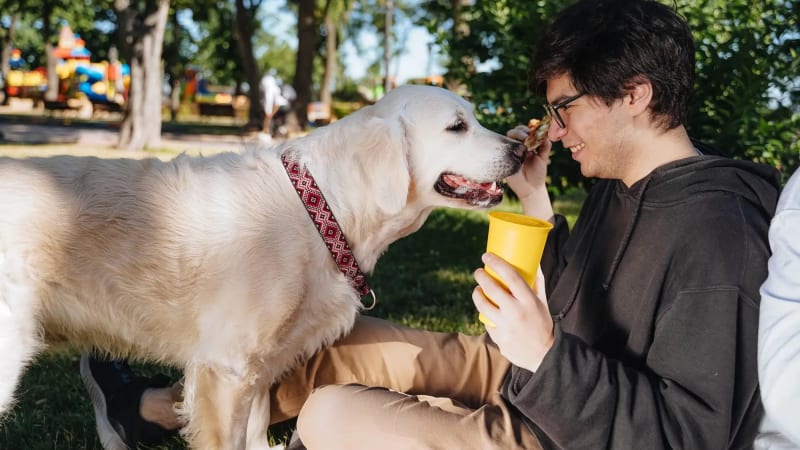
Your dog is mid-sprint across the public park when a strange dog comes in fast and low. You get about three seconds to decide whether this is play or a problem. Anyone who has lived that moment has already wondered whether paying for an empty, fenced acre is worth it. The honest answer is that private dog park cost lands somewhere between a fancy coffee and a full day of daycare, and where exactly it lands depends on numbers most listings never spell out. Here is all nine of them, plus the math on whether the whole thing pays off.
What Is a Private Dog Park?
A private dog park is a fenced, off-leash space you rent by the hour for your dog alone. No other dogs. No negotiating with a stranger about whether their dog is friendly. You book a slot, you drive over, you get the gate code, and for that hour the place belongs to you.
Most of these spaces are ordinary backyards, horse paddocks, or unused pasture that someone listed on a booking platform. Sniffspot is by far the biggest of them, and it is the reason the category exists in most American towns at all.
A typical private dog park listing is an ordinary fenced backyard booked by the hour.
How Sniffspot Actually Works
The model is simple enough that people call it the Airbnb of dog parks, and the comparison holds up. A landowner lists their space with photos, fencing details, house rules, and an hourly price they set themselves. You search by ZIP code, pick a time, and pay per dog per hour.
Writing for Dwell in June 2025, Sophie Vershbow reported that the platform had grown past 28,000 listings, with roughly 90 percent of them inside the United States. The heaviest concentrations sit in Florida, Texas, California, Georgia, North Carolina, and New York. If you live in one of those states, you likely have a dozen options within a short drive. If you live in rural Montana, you may have one.
Private Dog Park vs Public Dog Park
The trade is straightforward. A public park costs nothing and gives your dog other dogs to play with. A private one costs money and gives you total control over who is inside the fence.
That control is the entire product. You are not paying for grass. You are paying for the absence of variables.
How Much Does a Private Dog Park Cost?
Most private dog parks in the US run $5 to $30 per dog, per hour, with $10 to $15 being the common middle. Dwell's 2025 reporting put the national range at $5 to $30 an hour, citing a $5 spot in Nashville and $15 spots in Maryland and Colorado. Arizona PBS newsroom Cronkite News reported a Phoenix-area backyard renting at $12 per dog per hour.
Here is the full picture of what you actually pay:
Cost line
Typical US figure
Notes
Base hourly rate
$5 to $30 per dog
Set by the host, not the platform
Common midrange
$10 to $15 per dog
What most suburban spots charge
Second dog
50% of base
Per Sniffspot's published discount
30-minute visit
75% of the hourly rate
Not half price
Membership
From $20/month
Credit-based, covers roughly 1 to 2 visits at the entry tier
Premium amenities
Top of range
Water features, agility gear, large acreage
Vaccines and preventatives
Prerequisite
DHPP or DA2PP, rabies, flea and tick
Fuel and drive time
Varies
Real cost people forget to count
Late cancellation
Full booking value
Cancel under 2 hours and you lose it
The Hourly Rate Range Across the US
Price tracks three things: acreage, fencing quality, and extras. A half-acre yard with four-foot chain link sits at the bottom of the range. Five fenced acres with a dog-safe pond, shade structures, and agility equipment sits at the top.
Canine Journal's review by Danielle DeGroot, who brings more than thirty years of canine care experience, found spots as low as $5 and others above $25 per dog per hour. That spread is real, and it is why a single national average would mislead you.
The Membership Credit System, Explained
This is where most people get confused, and where almost no review gives you a straight answer.
Sniffspot's membership starts around $20 a month for 21 credits, and the company says a typical visit burns 10 to 20 credits per hour depending on the spot, how long you stay, how many dogs come along, and any extras. Run that arithmetic and the entry tier covers roughly one to two hours of booking a month. There is a seven-day free trial to test it.
So the membership is not a buffet. It is a prepaid block. Here is the test that actually matters:
1. Count how many hours you realistically book in a month. Be honest, not aspirational.
2. Multiply that by the hourly price of your nearest good spot.
3. Compare that number to the membership tier that covers the same number of hours.
4. If you book twice a month or less, the entry tier is probably fine. If you book weekly, price the larger plans before committing.
Credit systems reward heavy, consistent users and quietly penalize the person who signs up in April and forgets by June. Check the current tiers on the platform before you subscribe, since pricing on these marketplaces changes.
The Two Discounts Most People Miss
Two published discounts change the math more than anything else, and neither one is obvious from a listing page.
The second-dog discount. Every dog after the first is charged at 50 percent of the base rate. At a $12 spot, two dogs cost $18 an hour, not $24. Over eight visits a month, that is $48 back in your pocket. Multi-dog households get the best value on these platforms, which is the opposite of what most people assume.
The 30-minute discount is not half. A half-hour visit, where the host allows one, is priced at 75 percent of the hourly rate. At that same $12 spot, 30 minutes costs $9, not $6. Useful to know before you book two short visits thinking you are splitting the cost. For a dog who burns out in twenty minutes of hard running, it still beats paying for a full hour. For anyone else, the full hour is better value per minute.
Private Dog Park vs Daycare vs Public Park: The Real Monthly Cost
Nobody puts these side by side, so here it is. The scenario is one dog, twice a week, eight sessions a month.
Option
Cost per session
Monthly total
What you get
Public dog park
$0
$0
Free space, zero control over who enters
Private park, budget spot ($5/hr)
$5
$40
One hour alone, basic fencing
Private park, midrange ($12/hr)
$12
$96
One hour alone, decent amenities
Private park, premium ($30/hr)
$30
$240
Acreage, water, agility setup
Doggy daycare, lower end
$25/day
$200
Full day, supervised, group play
Doggy daycare, upper end
$65/day
$520
Full day, urban premium facility
Two dogs at that midrange $12 spot pay $18 a session, or $144 a month thanks to the second-dog discount. Two dogs in daycare pay roughly double, since daycare prices per dog with no comparable multi-dog break.
The pattern is clear. A private dog park is not competing with the free public park on price, and it never will. It is competing with daycare, and against daycare it usually wins on cost by a wide margin. What it does not give you is eight hours of supervision while you are at work. Different job, different product.
For anyone already weighing recurring pet expenses, it is the same kind of decision as working out whether pet insurance is worth the cost: the number only means something once you know how often you will actually use it.
Is a Private Dog Park Worth It? The Case For It
For the right dog, yes, and the reasoning is stronger than convenience.
What the Research Says About Public Dog Park Risk
The most useful evidence here is not marketing. A systematic review by Rahim and colleagues, published in the Journal of Community Health in 2017, examined the public health picture at off-leash dog parks and found genuine contamination.
Sampling in Calgary turned up parasites in half of the canine fecal samples collected, with Giardia in a quarter of them and Cryptosporidium in 15 percent. A separate study in southwestern Ontario found Campylobacter in 43 percent of samples. That is a meaningful load of pathogens sitting on ground where dogs sniff, dig, and drink.
The same review is refreshingly honest about what nobody knows. The authors state plainly that the frequency of dog bites to people inside off-leash parks has not actually been studied, and they note that most bites to children under 15 happen at home, not in public. So the fear of the public park is partly justified by the parasite data and partly just a fear.
That balance matters. Renting a private space genuinely lowers your dog's exposure to shared ground and shared water bowls. It does not make your dog bulletproof, and no honest write-up should claim otherwise. Keeping your dog's flea and tick preventative current does more for parasite risk than the venue ever will.
Who Gets the Most Value
The people who get their money's worth share a clear profile:
1. Owners of reactive or fearful dogs. A dog who cannot cope with a surprise greeting gets a full hour of freedom with zero surprises. This is the strongest case there is, and it pairs well with the work you do on dogs who struggle with anxiety and reactivity.
2. People training off-leash recall. You cannot practice a reliable recall with three strange dogs in the picture. A fenced, empty acre is the correct training environment.
3. Multi-dog households. The 50 percent discount on every extra dog makes the per-dog cost drop fast.
4. Recovering or senior dogs. A slow sniff-walk in a safe space, with no risk of being bowled over by a young Lab.
5. Travelers. Renting an hour in an unfamiliar city solves the biggest problem of a road trip with a dog.
Joe Casados, Public Relations and Social Media Manager at the Arizona Humane Society, told Cronkite News that getting outside to run is a significant enrichment activity for dogs, and that anything making pet ownership workable for more people is a good thing. That framing is the right one. This is enrichment, not a luxury add-on.
There is a demand story behind it too. The American Veterinary Medical Association reported from its 2025 Pet Ownership and Demographic Sourcebook that dogs now live in 42.6 percent of American households, an estimated 87.3 million dogs. Public park capacity has not grown to match. The rental market grew into that gap.
For a reactive dog, an empty fenced field is the whole value of the booking.
When a Private Dog Park Is NOT Worth the Money
Somebody has to say this part, so here it is.
Skip it if your dog is well socialized and you have a good public park nearby. A confident, friendly dog with a decent local park is already getting what the rental sells, plus playmates, for free. Paying $96 a month to remove other dogs from a dog who enjoys other dogs is spending money to subtract value.
Skip it if your nearest listing is a 40-minute drive. A $12 booking with 80 minutes of round-trip driving is not a $12 booking. Fuel and time turn a cheap hour into an expensive afternoon, and you will stop going by week three.
Skip it if your budget is already tight. Vet care, food, and preventatives come first. Recurring enrichment spend is a nice-to-have, and a long sniff-walk on a quiet route at 6 a.m. costs nothing and does real good. Thinking through how much outdoor time your dog actually needs is free and often more useful than a booking.
Be cautious if you are buying it to fix a behavior problem. A private space is a fantastic training environment. It is not a training program. Reactivity and severe anxiety need a qualified behavior professional, and the rented acre is where you do the homework they give you.
What You Need Before You Book
Vaccination and Parasite Requirements
Sniffspot requires that every visiting dog be current on DHPP or DA2PP, which covers distemper, hepatitis, parainfluenza, and parvovirus, plus rabies, or carry current titers instead. The platform also requires an up-to-date, vet-recommended flea and parasite preventative. Guests self-certify and agree to produce proof if asked.
Sort this out before you book, not in the parking lot. If you are unsure where your dog stands, our dog vaccination schedule walks through core versus non-core shots and the timing for every life stage.
How to Vet a Listing: A 7-Point Checklist
Photos flatter every yard. Run through this before you pay:
1. Fence height and type. A four-foot fence does not hold a determined Husky. Look for a stated height, and look for gaps at ground level.
2. Buffer time between bookings. Some hosts schedule back-to-back with no gap, which means you may meet the next guest at the gate. Ask.
3. Line of sight to neighboring dogs. For a reactive dog this is the whole ballgame. A private yard with three barking dogs behind the fence is not private in any way that matters.
4. Water and shade. In a Phoenix or Tampa summer, an unshaded lot is unusable after 9 a.m.
5. Surface and hazards. Foxtails, standing water, loose gravel, and unfenced pools are all common and all worth asking about.
6. Cleanup rules. Know whether you are expected to bag and carry out, and bring your own bags regardless.
7. Recent reviews only. A glowing review from 2023 tells you about a yard that may have changed hands.
Cancellation and Booking Rules
Sniffspot's published policy lets you cancel or move a confirmed booking up to two hours before the start time for a full refund. Inside that two-hour window, you are paying whether you show up or not. Weather is the usual culprit, so watch the forecast the morning of.
Minors are only permitted when a parent or guardian books and stays present throughout. The platform also bars users with certain criminal convictions, including animal cruelty offenses, and verifies users through credit card and fraud checks.
A Real Example of How Busy These Get
Dwell's 2025 feature followed Danni Bova Keane, who listed her backyard in January 2023 at $15 per dog per hour. By the time the piece ran, that single yard had been rented roughly 800 times.
Sit with that number. One suburban backyard, eight hundred bookings, in about two and a half years. That is not a novelty product that a few people tried once. That is a neighborhood full of dog owners who found something they could not get anywhere else and kept coming back.
FAQ
Most spots charge $5 to $30 per dog per hour, with $10 to $15 typical. Every dog after the first is 50 percent off, and 30-minute visits are priced at 75 percent of the hourly rate.
For reactive dogs, off-leash recall training, multi-dog households, and travelers, yes. For a well socialized dog with a good public park nearby, the free option usually wins.
Current DHPP or DA2PP and rabies, or valid titers, plus a vet-recommended flea and parasite preventative. Owners self-certify and must provide proof if requested.
Per session, yes, by a lot. Eight one-hour visits at $12 come to $96 a month, against $200 to $520 for eight days of daycare. Daycare buys supervised hours, not just space.
Yes, up to two hours before your start time for a full refund. You can also move the date or time within that same window.
Final Verdict: Should You Book One?
A private dog park is worth it when you are buying control, and a waste of money when you are buying grass. The private dog park cost of roughly $40 to $100 a month for a twice-weekly habit is real money, and it is also less than half of what the same schedule costs at daycare.
Run the numbers on your own dog before you subscribe to anything. Check the hourly rate at your two nearest spots, add the drive, apply the second-dog discount if it applies, and compare that to what you are spending now. If your dog freezes at the sight of a strange Shepherd, the math will almost certainly work. If your dog's favorite hour of the week is chaos with six other dogs, save your money and keep going to the park.
Have you tried a private dog park with your dog? Tell us in the comments what you paid and whether it was worth it, and share this with the friend whose reactive dog has not had a proper off-leash run in years.
Published by Pet to Bay
Pet to Bay Editorial Team
Published by Pet to Bay, a pet care resource that researches dog and cat topics from veterinary studies, national bodies, and primary sources rather than opinion. The team covers health, behavior, nutrition, and the real cost of pet ownership for American pet parents.
Know the Real Private Dog Park Cost First
Get honest, source-backed guides on what dog care actually costs, sent straight to your inbox.
The research on dog water fountains is surprising. Learn how much water your dog needs, a 2-week fountain test, and when extra thirst means a vet visit.
"Premium" has no legal meaning on a dog food bag. Find out what actually separates good food from expensive food, real US costs per day, and when paying more makes sense.